Puppy Blues: How We Survived a Year of Moving and Training
This is the messy, true story of how we raised a puppy while moving nearly every month for a year in California.
What You’ll Learn
How to raise a puppy while living in multiple short-term rentals.
Practical potty-training strategies for small or temporary spaces.
Tips for navigating landlord approvals and dog-friendly housing.
Ways to manage relationship stress while sharing puppy responsibilities.
Tools and routines that keep your puppy happy, safe, and secure during frequent moves.

Liam and Rocky doing a photoshoot in our backyard in Oakland, California. April 2021.
The California Dream and Our Guard Dog
We moved to California in January of 2021, nearly a year into the craziness of COVID.
Before that, we were living in our home state of Michigan.
I was working with a nonprofit in Lansing and Liam with an engineering company in the sewers in Detroit. We dreamed of moving out to Colorado (we lived there for a summer in 2019) but knew we’d need jobs if we wanted to do that.
We both landed jobs in California, and that seemed good enough. We packed up my grey Prius and Liam’s bright red Prius, loaded them with everything we owned, and trucked it out to Oakland, California.
Sure, we wanted Colorado, but Cali was hiring, and we wanted the adventure.
Our couples travel got real, fast.
My job with a local community services agency felt so aligned, like I was going to do good work and fit right in. But in the middle of a workday, I was held up at gunpoint going to grab my lunch. It sucked, and it scared me.
Liam got the notification on Citizen, and had a weird feeling it was me based on the description of the person and weapon. He picked me up and we drove to Santa Cruz, to sit on the beach and try to process the shock.
The universe wasn’t done with her chaos, though.
The next morning, we came back home and wanted to take Liam’s Prius to the store. We turned it on and heard that deep, motorcycle revving roar. Yup, Liam’s catalytic converter had been stolen.
It was classic, frustrating California chaos, a nice little “welcome-to-the-real-world” moment.
Naturally, I wanted a dog for protection. I don’t think Liam was as keen on the idea, but he eventually agreed and I began the search.
The problem was: responsible adoption orgs or rescue places all rejected us.
And they were right to reject us according to their rules. But, I think if they gave us an interview or spent a couple more minutes talking with us, they would have realized we actually are responsible dog owners, we just also have a mobile lifestyle. Remember, it was COVID times and people were adopting and buying dogs and pets like crazy.
We were desperate, so we (I- it was me) turned to Craigslist. (PS- I now volunteer and foster with the humane society here, and I know how important it is to adopt, don’t shop. Please forgive me!!)
I located an ad, made a call, received some photos, and decided on a day to see him. We drove to Sacramento, met a lady in a Walgreens parking lot, and paid cash for our sweet, fluffy puppy.
Although we went there committed to really being carful, asking the right questions, and inquiring about the mom and dad, once we held him and brought him into our car, we were done for.
We knew something was up with the situation, it was weird and slightly sketchy, but it wasn’t enough to stop us from bringing this little floppy puppy home.
The first trip to a real vet confirmed what we were thinking and seeing. His papers were fake, his vaccination records were useless, and he was likely only about five weeks old, too young to be separated from his mom.
Our puppy journey began with a lie and a cash transaction in a parking lot.
The Career Pivot That Saved Our Mobility
Although we secured permission from the Airbnb we would be staying in Sebastopol, CA, when we confirmed everything the week before, the owners went back on their word. (Hot tip: we should have gotten this permission in writing).
They were so excited for us leading up to it, sending us photos and telling us stories about their dogs as puppies… but I guess rich people stay rich by keeping 1.5 months of our housing stipend and leaving a young couple scrambling to find a place to stay over a long weekend.
The setup with Liam’s job is that we have a “permanent” residence and he gets a housing stipend if the job is over a certain amount of miles away.
But after being held up, I was pretty adamant: I’m not staying alone in the Bay Area while Liam was on site in Santa Rosa. I just wasn't doing it.
Oakland is amazing- it has the best food I’ve ever eaten at almost every single restaurant, and the city’s vibe is vibrant and alive. The catalytic converter theft and my scare were simply part of our specific, terrible luck.
Okay, so now we needed to find a rental closer to the job site for me, Liam, and our tiny little puppy. And I needed to find a new job.
Thankfully, I was able to work remotely for my Michigan nonprofit organization while searching for another job.
After lots of sifting through job postings, I found an ad for a nonprofit therapy group looking for an associate therapist. They paid decently and would provide supervision and support to become a licesned theapist.
But when I tried to click, the link went to an error page. I dug. I googled the name of the group and wound up on a private facebook page for the owner. Her email address was on the page, and I decided to just send it with an email containing my resume and cover letter.
I got an interview the next week, and secured the job shortly after.
It was the dream setup we always talked about: a mobile career that I love, pays OK, and allows Liam, Rocky and I to travel around together without risking income.
The mid-day robbery and nasty behavior by the Airbnb owner was bittersweet, but now mostly sweet because they made our dream nomadic couple life possible.
The 200 Sq Ft Stress Test
With Rocky packed up, we quickly moved into a tiny house (that we secured in about 2 days!!) in a neighborhood in Santa Rosa.
It was an adorable, garden-level 200 square foot tiny house, which turned out to be a strange kind of positive. (Though I can safely say I hope I never have to do run my virtual therapy sessions from the toilet again).
Puppy Training Tips for Small Rentals
How do you potty train a puppy when his environment changes every few weeks, and your current rental is small?
Our life became a real-world answer to the search query: "potty training puppy in small apartment."
We developed a system that worked to potty-train a puppy in a rental:
Pads and Praise: For the first two weeks, it was all about potty pads and extreme positive reinforcement. When he went where he was supposed to, we celebrated hard: treats, good-bois, the whole shebang.
The Observation Game: After those first two weeks, I was constantly observing him. I learned to read his body language and noice that split second where he’d look distracted or start circling before he needed to go. The second I saw it, I’d grab him and rush him outside. He’d go, and we’d celebrate.
The Tiny House Advantage: The physical layout of the Santa Rosa tiny house was helpful. The door to a small outdoor area was right by the head of our bed made midnight and early morning potty breaks easy.
Make Puppy Car Time Easier
Despite the tiny space, we knew we had to give Rocky something that felt constant. As a couple who travels for pleasure and work, our only real constant was the car.
We made the car so fun. Treat time, the best toys, a place where he always got a kong stuffed with something delicious or a meat chew.
Being in the car was the one thing that was consistent in all our moves, and by turning it into a reward center, it helped ease the stress of constant transition.
The Real Relationship Test: Liam vs. Rocky
The messy emotional truth is that raising a puppy is the ultimate relationship stress test.
Since I pivoted to working from home, I was with Rocky 24/7. I got all the positive interactions and was exhausted by the time Liam got home from the job site.
Which meant, Liam was met by an overstimulated, "terrorizing" puppy who’d nip and jump on him.
This caused tension.
We had different dog-raising philosophies, too. I had a fearful dog right after college who I eventually had to put down for behavior issues. It was heartbreaking and caused signifiant complex grief, guilt, and serious determination to do everything I can with my next dog.
I was in total dog-training mode, focused on positive reinforcement and every modification possible.
Liam had the perfect family dog growing up (a dog that, according to him, "didn’t need any training.") He was anti-treats, didn’t really understand positive reinforcement, and thought it should all be easier and Rocky should just listen and comply.
The conversation that fixed this wasn't confrontation, it was recognizing what was actually happening and responding with curiosity and creativity. I realized my presence was creating an imbalance.
We created a new routine:
When Liam got home, instead of trying to engage with the wild puppy right away, they would take a low-pressure walk together after Liam had a chance to settle down.
Liam began doing more of the core caretaking, like feeding and doing the early morning walks. This built their bond outside of a playtime frenzy.
I stopped over-correcting, even if I thought I was being helpful or looking out for him. It’s not helpful to correct your partner’s every puppy-raising misstep.
It took a couple weeks, at times it was frustrating, but it worked.
Liam and Rocky became best friends as their own bond grew through these shared responsibilities.
The Unbreakable Team
Because Rocky had a mystery early puppyhood, and since he was our first dog, we were pretty vigilant about his health.
We were constantly moving and I was stressed about neglecting his care, but we didn't want to spend hundreds on unnecessary emergency vet visits.
Knowing this stress, Liam found an app that let us make a quick virtual appointment with a vet who would tell us instantly if we needed to rush to the ER, go to a clinic, or simply monitor him. It was called FirstVet and cost about $8/month for this virtual vet service.
The act of acknowledging my stress through finding a helpful tool was extremely loving. It relieved so much pressure and allowed both of us to take the lead on Rocky’s care.
Nomadic Hacks and Tiny Date Nights
Over ten months, we lived across the Bay Area and Northern Califronia: Oakland, Sebastopol, Santa Rosa, El Cerrito, Rohnert Park, Guerneville, and San Francisco.
Each move required us to become experts in the search query: "how to get a rental to approve a puppy."
Winning Over Non-Dog-Friendly Landlords
We couldn't rely on long-term rental agreements, but we (almost) always succeeded in finding a place, even in properties that initially said "no dogs."
Our secret was (and still is today!) the Rocky resume and being proactive.
We use reviews from past Airbnb hosts and previous landlords who could vouch for him. We tell the new landlord that we have a very sweet, non-destructive, reliably potty-trained dog, backed up with a picture or video.
When people met him, they see his sweet temperament and can sort of feel that he’s not a problem.
That little bit of trust and preparation make all the difference and is one of our most valuable hacks for a couples travel lifestyle.
Living in Love in a Garage
Of all the temporary homes, our time in a garage apartment in San Francisco’s Mission district provided the unexpected date night that saved our sanity.
The apartment itself was rough: we had an air mattress, a table and chairs, and a desk. It was tiny, sort of gross due to the whole basement location, and chaotic.
We knew that COVID dogs could have separation anxiety, so I would leave Rocky alone for short bursts during the day. Usually for 30 minutes, an hour maybe.
Eventually, we decided Rocky was stable enough for us to leave him alone for the first time and we wanted to have a first date night since getting the puppy.
We set up my laptop with a Google Meet running, connected it to Liam’s phone, and carefully walked down the hill. We headed to Recovery Room, a laid-back bar we frequented with Rocky because of their outdoor area.
We spent a lot of the evening watching the puppy cam on Liam’s phone, trading it back and forth every five minutes.
It was wild to be checking a live video of a dog sleeping, but it helped us realize it would be OK to leave him alone.
We felt like “OK, we did a pretty good job here, for the most part.”
Guerneville and Rohnert Park Sanity Checks
The constant moving required us to find small moments of normal.
When we were staying in Rohnert Park and Guerneville, we were often near vineyards and state parks.
We had to adjust our date nights to become "day dates" that involved Rocky or choose places with outdoor, dog-friendly patios.
One of our favorite spots in Gurneville is Stumptown Brewery - we could walk across the river from out house to their lawn, which doubled as a dog park.
We also found trails, picnic spots, and outdoor areas where we could relax, which was a huge mental relief from the stress of living in small, often crammed places.
It wasn’t easy to raise a puppy across 10 short-term rentals, but we made it work.
The Unexpected Lessons in Mobility and Repair
Raising a puppy while constantly moving was the ultimate stress test for our relationship and our sanity.
The chaos of our housing situation, from the stolen catalytic converter to the last-minute rental scams, forced us to be flexible and use proactive problem-solving.
While we focused on giving Rocky consistency (especially through the car), the biggest repair was to our own foundation as a couple.
The "Puppy Blues" is real, and for us, it wasn't about romanticizing the struggle- it was about learning to manage emotions and logistics as a team.
The lessons we learned were about communication, preparation, and support.
Ultimately, finding ways to support your partner's stress (and not criticize their coping mechanism) is an act of intentional love and adoration.
It’s worth the effort.
Your Nomadic Puppy Toolkit
This entire journey was (still is) a masterclass in problem-solving.
If you’re struggling with a puppy, relationship stress, or constant moving, these are the three core strategies that kept us sane and successful.
1. Housing and Mobility Hacks
Create a Puppy Resume: Don't rely on being a "nice person." Create a document for your dog. Include pics, a reference from a former landlord or vet, and a letter confirming they’re neutered and reliably potty-trained.
Insist on Written Permission: For short-term rentals, ensure the dog approval is clearly documented in the official messaging thread or a signed agreement. A verbal “yes” isn’t always enough.
The Power of Proximity: Use your new pet as motivation to secure housing closer to your or your partner's work. The reduction in commute time and the ability to see your dog at lunch drastically reduces stress.
2. Partnership and Conflict Repair
Identify the Imbalance: If one partner is the primary caregiver or receives all the puppy bites/negative interactions, that partner's stress will rise. Trade off on responsibilities and give each other a break.
Re-Engineer Bonding: Create a daily routine that focuses on low-pressure bonding for each partner. This includes all core activities: feeding, early morning walks, and bedtime routines. This builds trust without the chaos of playtime.
Compassionate Response: Find tools to mitigate you and your partner's key sources of anxiety. For us, this was the virtual vet service and stepping up when the other needs a break.
3. Puppy Training and Consistency
Positive Reinforcement: Figure out your pups favorite rewards and use them for potty training, behavior management, and training. Ignore “bad” behavior.
Constant Car-sistency: If you travel frequently, make the car a positive, rewarding space. Offer high-value chews, Kongs, and treats in the car to turn it into a party, not a source of stress.
The Observation Game: Potty training a puppy in a rental requires extreme vigilance. Learn the specific "look" or "circle" your puppy does right before they go, and take them outside immediately. Respond to an accident by taking them outside, do not yell or punish.
Outdoor Dates: The "Puppy Blues" can leads to social isolation. Adjust your date nights to "day dates" that involve the dog, or choose local, dog-friendly patios and picnic spots until your pet is stable enough to be left alone for longer periods.
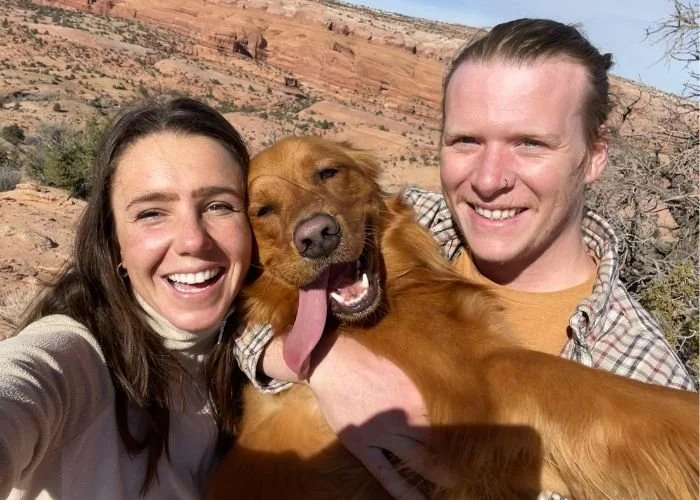
Me, Rocky, and Liam in Moab, Utah sometimes in Spring 2022ish? All of the challenges have helped us get to this point.
What began as a cross-country move to California and an impulsive decision to get a puppy ended up teaching us the most valuable lessons about partnership.
We survived the puppy blues across ten different rentals, and we transformed our anxiety and instability into a clear system for working as a team.
The truth is, whether you’re moving every month or simply trying to make it through the week, raising a dog with a partner requires intentional communication and proactive support.
By acknowledging stress, re-engineering your routines, and finding simple hacks, you can turn a challenging experience into the most rewarding chapter of your relationship.
Key Takeaways
Raising a puppy while moving often is possible with planning, consistency, and communication.
Positive reinforcement, observation, and routine are your best tools for successful potty training.
A “puppy resume” and clear agreements with landlords can make non-dog-friendly rentals accessible.
Sharing responsibilities and repairing imbalances strengthens both your relationship and your dog’s well-being.
Flexibility, preparation, and small intentional routines turn chaos into a rewarding experience for you, your partner, and your pup.
Did the "Puppy Blues" reveal a crack in your communication?
If you're ready to have better intimacy, learn to apologize better. Read our most popular post on The 4 Steps to an Apology That Truly Heals.